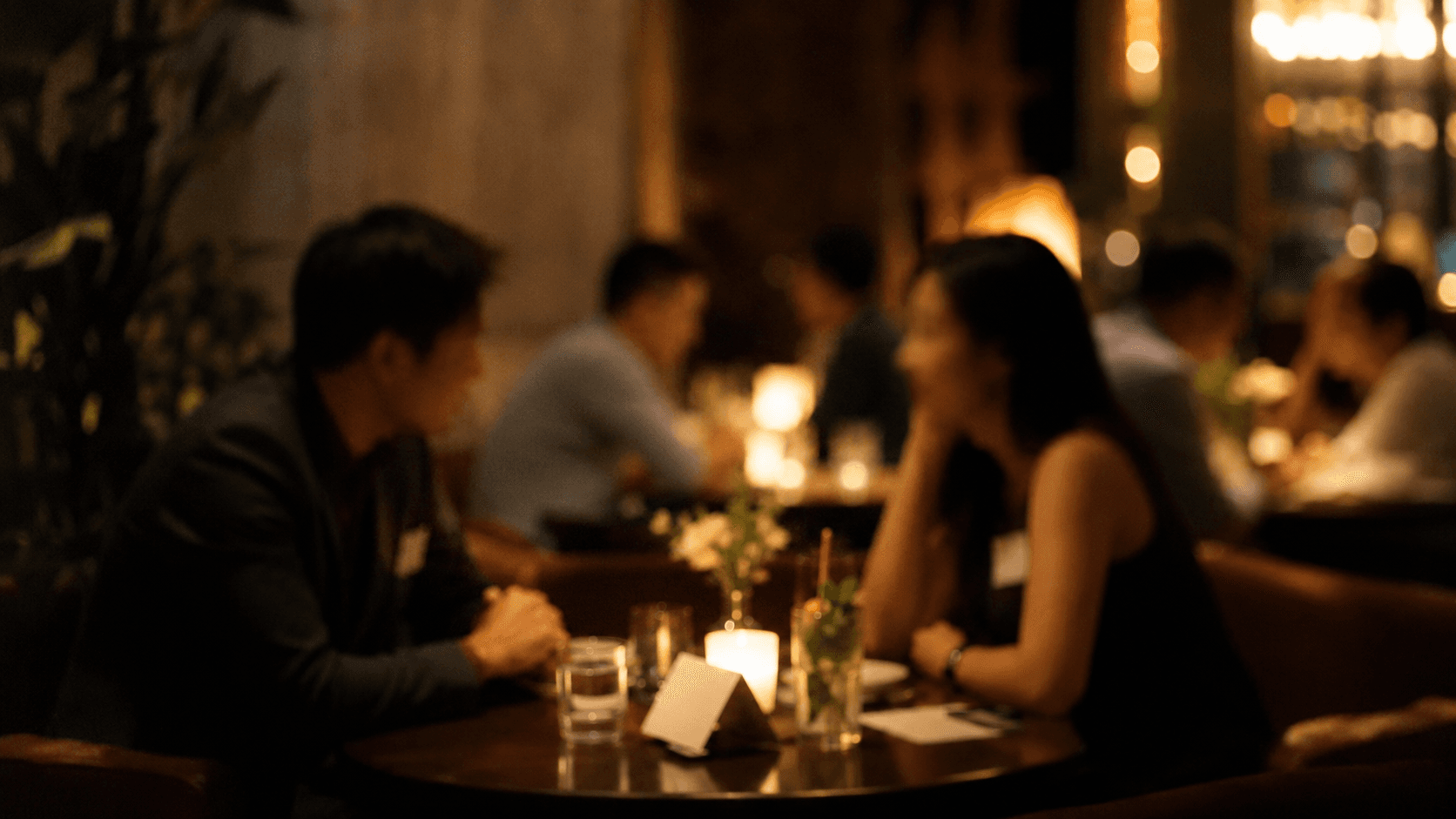
After attending two OMG matchmaking events in Saigon, the April evening event and the June coffee format, trying a different organizer was the logical next step. Signal Saigon came up through Instagram, likely from a paid ad. The impression from the outside: Korean-run, male organizers, supported by local Vietnamese women. Less polished than OMG in some areas. More effective in others.
The format was different from anything I'd attended before. Not a coffee concept. Not one-on-one seven-minute rounds. Signal Saigon uses a group table format: small mixed groups, longer rounds, a wine lounge as the venue. Group tables for 25 minutes per rotation instead of one-on-one for seven changed who the format favors and what it measures.
The result was seven matches from roughly twelve women. At 490,000 VND, that's a strong return.
Key Takeaways
Group table format (25 min per table) tests sustained presence, not opening energy — helps men who improve with time
Sign-up process was the weakest part: web app errors required 5–6 form attempts
Same-night match results via envelope — faster closure than OMG's next-day app system
Signal Saigon uses one-way matching: if a woman selects you, you get the match regardless of whether you selected her — OMG requires both sides to choose
490,000 VND vs. OMG's 900,000–1,000,000 VND — better price-to-result ratio
Male table partner quality affects results directly — misaligned pairing creates friction
7 matches from ~12 women: 58% hit rate after 25-minute rounds
Table of Contents
Sign-Up Experience
Rating: 3/5
Signal Saigon uses their own web app for registration. The concept is reasonable. The execution was not.
Submitting the form through Chrome produced errors on every attempt. Switching to Firefox eventually worked, but it took five or six tries to get through. A man who is already unsure about attending doesn't need an extra reason to stop at checkout. Repeated form errors at payment is exactly that reason. The form should work on the first attempt in any major browser.
When I messaged Signal Saigon about the issue, they were responsive. At the time, they only accepted phone numbers for contact, presumably because they use Zalo to coordinate with participants. I suggested they add email as an option. They did. They also said they'd fixed the form error. Whether that was fully resolved on their end, my experience was still frustrating.
Two things worked well. First, the payment process: a bank transfer QR code, half as a deposit up front, the rest collected at the event. Clean and straightforward. Second, the deposit model filters for committed participants. People who pay in advance show up. People who pay nothing often don't. That's a smart design choice even if it wasn't framed that way.
Communication throughout was good. I asked whether non-alcoholic drinks would be available before the event. They answered quickly. I messaged around 1 AM after the event to follow up on something and they replied within a reasonable window. The responsiveness offset some of the friction in the sign-up flow.
The Venue
Rating: 4/5
The event was held at a wine lounge in a good area, more expat and business district than tourist strip. From the outside, the space looked like a wine shop with retail bottles at the front and the event space running behind it. The exterior lighting was clean and the location felt intentional.
Inside, the lighting ran slightly too yellow. Not uncomfortable, but it flattened the atmosphere. A wine lounge should feel warm; this read more like a meeting room that sold wine on the side. The rectangular tables reinforced that. Face-to-face across a table creates more formal energy than angled seating.
The bigger issue was signage. Arriving at 6:30 PM for a 7 PM start, there was nothing outside indicating an event was happening. No sign, no visible staff, no participants obviously waiting. A quick message to the organizers confirmed the location. First-time attendees who don't know to message ahead could easily turn around.
Once inside, two doors led to the event space. The room had glass panels, so the setup was visible before entering: four tables, reception on the right. Check-in was quick: name, remaining payment, matching cards. The location works and the concept fits the format. Lighting, table layout, and signage are the three things worth fixing.
The Format — Group Tables vs. One-on-One Rounds
Rating: 3.5/5
Signal Saigon's format differs from every other speed dating event I've attended in Saigon. Instead of seven-minute one-on-one rounds, participants sit in small mixed groups, roughly two men and two or three women per table, for approximately 25 minutes before rotating.
Seven-minute rounds reward fast energy. A man who opens confidently, asks sharp questions, and closes strongly can create a compelling first impression in that window regardless of what comes after. Early-stage appeal relies heavily on signaling: presentation, energy, the quality of the first few exchanges.
Twenty-five minutes at a group table exposes more. Conversation has to develop, change direction, recover from dead ends. The other man at the table is visible throughout. Humor has to land more than once. Social calibration becomes harder to fake. For men who improve with time, whose personality opens up over 20 minutes rather than 5, the group format is a structural advantage.
The games helped. The first activity involved guessing each participant's profession from a list of clues, a functional icebreaker that forced specific conversation without defaulting to the usual interview questions. The second game, a condensed version of Never Have I Ever with five fingers instead of ten, ran tighter than the same game at other events and reached a clear winner without dragging.
The structural gap was instruction. With two men and two or three women at a table, the social contract isn't obvious. Do you address questions to the group? Focus on one woman while others listen? Let the other man lead? The event didn't clarify this, which meant the dynamic at each table depended heavily on whoever happened to be most socially assertive. Question cards with deliberate prompts around values, lifestyle, and what participants are looking for would reduce that variance.
The Male Pairing Problem
This deserves its own section because it affected multiple tables.
In one-on-one speed dating, your result depends on you and the woman across from you. In Signal Saigon's group format, it also depends on the man next to you. A socially aligned male partner can make both participants look better, building off each other's energy, creating a fun group dynamic, making the women feel like they're at the most interesting table in the room.
Women's interest is partly socially certified: how a man holds himself in a group, and how others respond to him, forms part of how he registers. A discordant male pairing undercuts that. At several tables throughout the evening, the two men were not aligned. Conversation went in conflicting directions, momentum broke before it built.
The clearest proof came from the other direction. Two men at another table were working together, coordinating questions, building off each other's answers, making the round feel like a conversation rather than an interview. Women who sat at their table mentioned afterward it was the best round of the night.
Signal Saigon advertises a friend discount, so bringing someone is explicitly supported. The assumption is that two men attending together would be seated at the same table, which gives you more control over the pairing dynamic. If you bring a female friend, they may separate you or you may be able to request a specific seating arrangement. Either way, if you're attending with someone, it's worth asking Signal Saigon directly how they handle it before the event.
The Participants
Rating: 4/5
Signal Saigon had roughly the same number of women as OMG's events, around 12. This isn't an event with a larger pool. What differed was the overall impression: the women at Signal Saigon felt more attractive on average than what I'd experienced at OMG's events.
Some of that is explained by the matching mechanism. At Signal Saigon, matching is one-way: if a woman selects you on her card, you receive that match regardless of whether you selected her. This means you find out which women were interested in you even when you weren't certain during the round. At OMG, both parties must select each other for a match to register, so you only see mutual interest. Knowing a woman selected you changes how you read the interaction in retrospect — a woman who seemed reserved during the round but still wrote your name down is telling you something you wouldn't learn at OMG.
The age distribution at Signal Saigon was similar to OMG: most women appeared to be in their 30s, with roughly one woman under 30 at the event. This isn't specific to Signal Saigon. Across paid speed dating events in Saigon in this price range and format, the majority of female participants tend to be 30 and older. Men who strongly prefer dating women in their 20s should factor that into expectations before attending any of these events.
Most women were willing to speak English when asked. At Clique83, another Saigon speed dating organizer, the crowd skewed heavily Vietnamese and most participants stayed in Vietnamese throughout, which made engagement harder for non-fluent attendees. At Signal Saigon, the majority accommodated English with reasonable comfort, though mixing Vietnamese in where appropriate helped build rapport at certain tables.
At one table, there was one woman who was clearly the most attractive person I'd spoken to that evening. She didn't speak much English, but another woman at the same table helped bridge the conversation. The dynamic at that table was natural enough that I exchanged Zalo contacts with both women directly during the round, without waiting for formal match results. Exchanging contacts during the round rather than after is a reasonable indicator the interaction was going well.
At another table, one woman's energy felt scattered and unfocused throughout the round, and a third woman at that table appeared significantly younger than the rest of the room, probably early 20s. That table was the least engaging of the four.
After follow-up over the days following the event, five women initially seemed worth pursuing based on first impressions or conversation. That narrowed to one woman worth actually setting up a date with. Most matches at any event of this size won't go further than a message exchange. The point of attending is to generate enough options that you have something real to filter through afterward. Signal Saigon generated enough options for that.
Match Results and What They Mean
Rating: 5/5
Signal Saigon delivers match results the same night. After all rounds completed, participants wrote names on physical cards. Organizers processed results on the spot. Within 10 to 15 minutes, everyone received a sealed envelope.
Seven matches from approximately twelve women.
That's a 58% hit rate after 25-minute group rounds. At OMG's April event, which uses mutual app-based matching after seven-minute one-on-one rounds, the match count was lower for the same man. Part of that difference is the mechanism: at Signal Saigon, a woman selecting you counts as a match whether or not you selected her. You don't have to choose each other. That means you see every woman who was interested, not just the ones where the interest was mutual.
This matters because it changes what match results tell you. At OMG, a match means she selected you and you selected her. At Signal Saigon, a match means she selected you, full stop. Seven matches from twelve women means more than half of the women at the event saw enough value in the interaction to write your name on their card after 25 minutes together. That's specific feedback about how your presence lands in a sustained group conversation, not just in the first impression.
Of the seven matches, I followed up with most of them the following day. One woman from the third table and I went out the same night. After more time together it became clear there wasn't enough there to pursue further. The woman I was most attracted to from the third table and I set up a date for later in the week. The rest of the matches received a message but I didn't actively pursue them further.
Price and Value
Rating: 4/5
The ticket cost approximately 490,000 VND, roughly a third to half the price of OMG's events.
For that price: three hours, four table rotations, two structured games, red wine, white wine, and non-alcoholic drinks. The assumption was that wine was bottomless, or at least no limit was enforced or communicated. For men who drink, the price-to-value ratio is strong.
The deposit model filters for participants who are committed enough to pay twice. No-shows at Signal Saigon were low. Events where participants pay nothing up front tend to have higher attrition, which reduces pool quality. A paid deposit is a small commitment device that improves the room.
At 490,000 VND, the bar for the event to earn its cost is much lower than at 900,000 VND. Even if no matches convert to dates, attending Signal Saigon gives you specific feedback about how you perform in a 25-minute group conversation format, which is different information than what seven-minute one-on-one rounds produce.
Signal vs. OMG — How They Compare
Both organizers run paid speed dating events in Saigon. The overlap ends there.
Dimension | Signal Saigon | OMG |
|---|---|---|
Price | ~490,000 VND | 900,000–1,000,000 VND |
Format | Group tables, 25-min rounds | One-on-one, 7-min rounds |
Match results | Same night, envelope | Next day, app |
Matching mechanism | One-way: her selection = your match | Mutual: both must select each other |
Hospitality | Functional, less warm | More polished, attentive |
Sign-up experience | Rough (web app errors) | Smoother |
Venue | Wine lounge | Cocktail bar / coffee shop |
Best for | Men who improve over time | Men with strong opening energy |
OMG's strength is polish. The hosting is warmer, the branding more practiced, the logistics smoother. For men who open strongly in short windows, the seven-minute format rewards that skill directly.
Signal Saigon's strength is value and the one-way matching mechanism. Lower price, longer exposure per round, same-night results, and a system that surfaces every woman who was interested rather than only mutual choices. For men whose personality develops over time, 25 minutes per table is a structural advantage.
OMG's weakness is price and that the mutual-match mechanism means you only see a subset of interest. Signal Saigon's weakness is onboarding and the randomness of male pairing. Running both at least once gives you a clearer picture of where you stand across different formats and different matching mechanics.
Would You Go Again?
Yes. The sign-up process was frustrating, the venue needed signage, and some table pairings hurt the dynamic. Seven matches from twelve women over three hours at 490,000 VND is enough to justify returning.
Dimension | Rating |
|---|---|
Sign-up experience | 3/5 |
Venue | 4/5 |
Hosting and hospitality | 3.5/5 |
Format | 3.5/5 |
Participant selection | 4/5 |
Price and value | 4/5 |
Match results | 5/5 |
Overall | 4/5 |
Go if you want a lower-cost alternative to OMG with a one-way matching system that surfaces more of who was interested. Go if your personality opens up over time rather than in the first 90 seconds. If you bring a male friend, ask Signal Saigon directly how they handle seating — the friend discount is advertised, and being seated together gives you more control over the table dynamic than being paired randomly.
Frequently Asked Questions
How does Signal Saigon's matching system work?
Signal Saigon uses one-way matching. Each participant writes names on a card at the end of the event. If a woman writes your name, you receive a match regardless of whether you wrote hers. This differs from OMG, where both people must select each other for a match to register. One-way matching means you see every woman who was interested, not just mutual selections.
How does Signal Saigon's format differ from OMG?
Signal Saigon uses group tables of 4 to 5 people for 25-minute rounds instead of one-on-one seven-minute rotations. Match results are delivered the same night via physical envelopes rather than the next day through an app. The price is roughly half OMG's ticket cost. The group format tests sustained presence over time; OMG's format tests opening energy.
Is Signal Saigon good for expats who don't speak Vietnamese?
Most participants at the event were willing to speak English when asked. At Clique83, another Saigon speed dating organizer, the crowd skewed heavily Vietnamese and most interactions stayed in Vietnamese throughout. Signal Saigon was more accessible for non-fluent attendees, though mixing Vietnamese in where natural helped at certain tables.
Can I bring a friend to Signal Saigon?
Signal Saigon advertises a friend discount, so bringing someone is explicitly supported. If you bring a male friend, the assumption is you'd be seated at the same table together, which gives you more control over the table dynamic. If you bring a female friend, they may separate you or accommodate requests. It's worth asking Signal Saigon directly how they handle it before the event.
What age range are the women at Signal Saigon and OMG events?
At both Signal Saigon and OMG events in Saigon, the majority of female participants tend to be in their 30s. Roughly one woman per event appeared to be under 30. This is consistent across paid English-language speed dating events in HCMC at this price range. Men who strongly prefer dating women in their 20s should factor that into expectations before attending.
How does the 490,000 VND price compare to other speed dating events in Saigon?
490,000 VND is at the lower end of the Saigon speed dating market. OMG charges 900,000 to 1,000,000 VND. At Signal Saigon's price point, the event produces value even if no matches convert to dates, because 25-minute group rounds give you specific feedback about how you perform in sustained conversation, which is different information than seven-minute one-on-one rounds.
Conclusion
Signal Saigon was not the smoothest event in Saigon's speed dating scene. The web app needs work. The venue needed signage. The group format needed clearer structure. The hosting was competent without being warm.
Seven matches from twelve women at 490,000 VND, with one converting to a date with the most attractive woman in the room. The one-way matching system means you see all the interest, not just mutual selections, which makes the result more informative than a comparable number at OMG. The group table format favors men whose presence compounds over time rather than peaks in the opening seconds.
For men evaluating speed dating in Saigon, Signal Saigon and OMG test different things and use different matching mechanics. Running both at least once gives you a more complete picture of where you stand than either event does alone.
Browse upcoming speed dating events in Bangkok and Saigon at LoveLTR's Bangkok dating events.