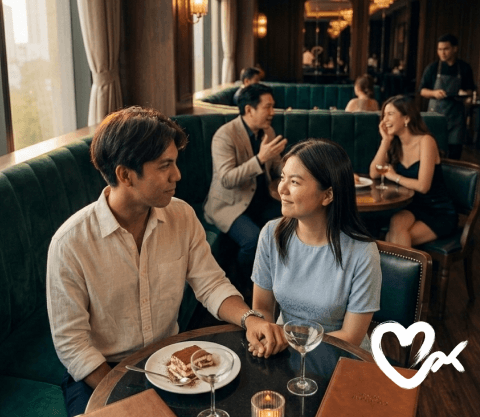
After the group activities, the event moved into the part most people would probably consider the center of the night: the one-on-one speed dating rounds.
This was also the point where the event’s structure became most legible.
Each participant was given a small red envelope, roughly the size of a business card, folded shut and marked by hand. Mine had my name written in white marker on the back and a small symbol, a heart. Inside, there were numbered spaces where I could later note the names of the women I wanted to connect with. The format had also been referenced earlier in the itinerary, so this was clearly one of the event’s more intentional mechanics. It served as both a matching tool and a physical reminder that the evening was moving toward selection, not just conversation.
There was also a practical system behind the table flow. Earlier in the night, the name cards had already shown which tables were assigned for the mini games and which would later be used for the one-on-one rounds. So by the time this phase started, the event was no longer improvising. It was running on a sequence.
And to be fair, this was one area where the event seemed more settled.
The pacing of the one-on-ones felt normal. The order made sense. The transitions were mostly smooth. If the earlier parts of the night had moments of ambiguity, this section felt more like the organizers had run the format enough times to understand the mechanics.
Where the Structure Finally Worked
That said, the process was not frictionless.
For one thing, I did not find the table numbering especially visible. More than once, I had to ask staff where I was actually supposed to be. That may sound minor, but in a speed dating environment, visibility matters. When the format depends on rotation and time pressure, even small confusion around seating creates unnecessary cognitive load. The smoother the logistics, the more mental bandwidth people can devote to the person in front of them.
Still, once the rounds began, the basic experience was familiar: short conversations, quick introductions, brief impressions, and constant movement.
One challenge became obvious almost immediately. You are meeting around ten women in succession, and unless someone leaves a very strong impression, their name often disappears almost as soon as it is spoken. That is not disrespect. It is just the reality of rapid sequence interaction. You hear a name, exchange a few questions, try to read their energy, and then move on. Then another person arrives, and the process repeats. By the middle of the rounds, the memory burden itself becomes part of the event.
That is one of the structural weaknesses of speed dating in general: attraction may happen in real time, but recall becomes messy afterward. The event gave participants a way to record interest, but the format still depended on remembering enough about each person to make a meaningful choice later.
That matters because one-on-one dating rounds are not only about conversation. They are about managing selective attention under compression.
Ten Conversations, One Missing Table
And that was very much my experience.
In general, I am comfortable talking to people. I do not use a rigid script, and I was not trying to run some elaborate funnel. My goal was simpler: get a basic read on whether there was enough interest, comfort, or curiosity to justify seeing someone again or at least continuing the conversation afterward.
Some women were easy to talk to. Some were clearly nervous. Some were shy in a quiet way. Some carried a stiff physical energy, sitting in ways that suggested discomfort, caution, or low engagement. I pay attention to that. Body language often tells you more than words do, especially in short interactions where everyone is trying to appear socially functional.
Language compatibility also continued to matter. Some women preferred speaking Vietnamese, which I can do to a degree, but not with the same ease or range that I have in English. So although I could still communicate, the conversation was naturally more constrained. You can still exchange information, but you are less able to improvise, tease, pivot, or express nuance. In speed dating, where each minute has to carry weight, that matters a lot.
One moment stood out in particular.
There was one woman from an earlier group setting who had previously insisted on Vietnamese. At the time, that made me assume there was little point in expecting much compatibility. So when I later arrived for our one-on-one, I was already prepared for a limited interaction. But when I reached her table, she was on her phone, looked up, and then said we could speak in English.
That caught me off guard.
My reaction was not that this suddenly made her a stronger match. It was that the earlier behavior now looked less fixed than I had assumed. In the group, she had closed off the English option. In the one-on-one, she reopened it. That did not change the overall lack of fit for me, but it did show how much behavior can depend on context. What looks like rigidity in one format may turn out to be selectiveness, mood, or simple convenience in another.
A Useful Design Choice
Another part of the structure that stood out was that although my card listed eleven women, I only actually had one-on-one conversations with ten. I noticed the gap and asked the organizer about it during the rotation. She told me it was intentional and that I would understand later. I accepted that and kept moving, but the detail stuck with me, especially because I had already identified the woman at that missing table as someone I was interested in meeting.
From a design standpoint, I thought this was one of the more interesting choices of the night.
Instead of making the event fully exhaustive, the organizers built in one point of managed scarcity. You could speak to ten people, but not all eleven. One interaction was withheld by design. Later, it became clear that this connected back to the White Day gift mechanic. In other words, the event was not simply arranging access. It was sequencing access and attaching one point of anticipation to the gift exchange.
That was clever.
It also created real tension, because in my case, the one person I did not get to speak to during the formal rounds was exactly the person I was most interested in. Had the event not provided a later mechanism for that, I would have taken the initiative myself and introduced myself outside the formal structure. But as an organizer move, it was smart. It gave the gift ritual an actual payoff instead of leaving it as a decorative theme element.
Small Frictions Inside a Good Format
There were smaller observations too.
At one point, one woman was making louder noises or reacting with enough energy that an organizer came over and addressed it. What stood out to me was not the woman’s behavior so much as the organizer’s response. She handled it in a subtle and professional way, without making the correction feel harsh or theatrical. That was one of the stronger moments of event management I noticed all night.
I also noticed one male participant repeatedly overrunning his time, staying longer with certain women before moving on. I let it go once or twice, but eventually I had to signal that he needed to keep the rotation moving. That is another recurring truth of speed dating: even when the structure is sound, it still depends on participants respecting the cadence. One person stretching the clock for his own conversation imposes a cost on everyone behind him.
As for the women themselves, the overall presentation level felt high. Compared with similar events in other cities, they were dressed very elegantly. The room felt polished, but also socially elevated in a way that signaled this was not a low-effort casual mixer. People had clearly prepared.
Where the Event Became Most Useful
Overall, this was the phase where the event worked best.
The one-on-one rounds were not perfect, but they were the first part of the night where the structure and the purpose aligned cleanly. Sit down. Introduce yourself. Read the person. Move on. Repeat. It was simple, direct, and appropriately compressed.
At the same time, this phase also made something else obvious: speed dating is not only about meeting people. It is about sorting signal from noise under unnatural conditions. You are trying to read chemistry, communication, comfort, and possibility inside very short windows, while also remembering names, managing language differences, and keeping pace with the room.
That is not a natural dating environment. It is an accelerated one.
And yet, that acceleration is exactly what makes it useful.
By the end of the one-on-one phase, I felt that the event had finally arrived at its strongest format. The earlier games had been uneven. The opening atmosphere had moments of ambiguity. But here, in the direct conversation rounds, the basic value proposition of the event became clear.
Not everyone was a fit.
Not every conversation had energy.
Not every interaction justified follow-up.
But the structure at least gave each person a defined chance to be evaluated.
And in a dating event, that is the whole point.