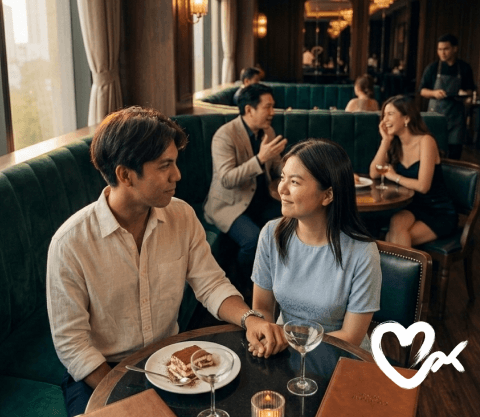
My first experience at Trying the Taste of Love, a speed dating event organized by Clique83 in Ho Chi Minh City, felt more structured and curated than a casual singles mixer.
Before the event, communication started by email and then shifted mostly to Instagram, which became the main channel for updates and instructions. The organizers also sent guidance beforehand, including conversation tips and a dress code, so it was clear they were trying to shape the experience before people even arrived. That gave the event a more managed feel from the outset, as if the goal was not simply to gather singles in one room, but to create the right conditions for interaction.
I had applied about a month earlier and was accepted fairly quickly, within the same weekend. Later, I spoke to some women who said they had applied much earlier and only received confirmation shortly before the event. That stood out because it suggested the organizers may have been actively balancing attendance, which makes sense for this type of format.
Even getting ready for the event reminded me that these experiences involve more than the ticket price alone. I took a Grab bike through the city, stopped at a coffee shop beforehand, bought a coffee mainly so I could use the washroom, and did my hair there before heading in. I was also traveling, so I was dressing from a limited wardrobe rather than a full closet. I wore a white undershirt, black cardigan, dress pants, and versatile white shoes. I felt reasonably put together, though not as polished as I might have been under more ideal circumstances. Looking around later, it also seemed that many of the men had interpreted the dress code loosely, so it felt more like a guideline than a strict standard.
Finding the Venue and Reading the Room
When I arrived, my first impression was confusion. I initially could not tell where the event actually was. It looked as though another function was happening downstairs, and I was unsure whether I was in the right place. I sat awkwardly for a moment, messaged the organizers on Instagram with a photo, stepped outside again, and asked someone next door if he knew where the event was. Only after taking another look did I notice a banner off to the side and realize the actual venue was upstairs in a lounge area.
That awkward entrance did not ruin anything, but it shaped the tone of the first few minutes. Instead of walking into a clearly defined event, I had to orient myself first. Once I got upstairs, though, the hosts were friendly and welcoming.
One of the first things they explained was a bingo-style icebreaker game. The concept was simple: walk around, ask people questions connected to prompts on the card, write down names, and try to complete a row. I understood what the organizers were trying to do. It was clearly meant to lower the barrier to conversation and give people a reason to approach each other.
When an Icebreaker Stays Too Passive
The idea made sense. The execution was less convincing.
By that point, many people were already gathered around standing tables in small clusters, which made it feel awkward to interrupt conversations just to ask checklist-style questions. I have been to other speed dating events where an activity like this is announced at a specific time and everyone begins together. That tends to work better because the room is aligned around the same task. Here, the bingo game felt more passive. It was introduced, but never really activated in a clear way, and by the end of the night it did not seem to be mentioned again.
So my impression was not that the bingo idea was bad, but that it functioned more as a conversational prop than a fully realized part of the event. For some attendees, that may have been useful as an excuse to start talking. For me, it did not feel like the right entry point into a room where people were already settling into small social circles.
I also noticed one woman off to the side speaking at length with one man, almost as if she had found a way to stay out of the broader circulation. Whether intentional or not, it illustrated the same point: once clusters form, a lightly structured icebreaker has less force unless the organizer actively resets the room.
There were also a few smaller details that reinforced the opening ambiguity. At one point I was not even fully sure who in the room was staff and who was simply attending, so I had to ask someone where I was supposed to sit. They helped me get oriented, and after that things felt smoother, but the first phase of the event did feel a little loose in terms of flow.
The White Day Gift Requirement
Another detail that stood out early was the White Day gift requirement.
A couple of days before the event, the organizers had messaged attendees saying that a gift was part of the experience. Since I arrived without one, I was told I needed to get one, either from them or from somewhere nearby. I had already paid around 2 million Vietnamese dong to attend, so in that moment it felt like an additional layer of required participation.
I stepped out, bought a simple White Day-appropriate gift from a convenience store, and then went across the street to Starbucks so I could get a bag for it. By the time I came back, I was a few minutes late, even though I had originally arrived early.
I would not frame that negatively, but it did stand out. It made the event feel more ceremonial and more intentional. Rather than simply attending, participants were being asked to contribute some visible form of effort. In that sense, the gift requirement seemed to function as part of the event’s social design. It added another layer of participation and signaling before the formal one-on-one conversations had even started.
Small Signals, Social Assumptions
There was also a complimentary drink setup. When I asked for soda water, the bartender seemed mildly surprised and suggested a cocktail instead. I told him I do not drink, and he brought me the soda water. It was a small moment, but it highlighted another assumption built into many social events: that alcohol is part of how people loosen up and connect. For someone who does not drink, that becomes more noticeable.
The first person I actually spoke with was another man, not one of the women attending. He introduced himself, asked where I was from, and we had a brief conversation. My sense was that he was dealing with the same situation I was: neither of us really wanted to force our way into one of the group clusters or use the bingo prompts to interrupt conversations that were already underway.
In that way, the first spontaneous interaction of the night came less from the event’s designed activity and more from two attendees independently navigating the same social structure.
That, in itself, was telling. Social events are not shaped only by what organizers intend. They are shaped by room layout, timing, conversational momentum, and the social cost of interruption. A structure can exist on paper, but if it does not fit the behavior already emerging in the room, people will create their own pathways through it.
A Curated Environment, Not a Casual Mixer
Overall, my first impression was that Trying the Taste of Love by Clique83 was a thoughtfully organized event aimed at a somewhat more professional and higher-investment crowd than a typical casual singles night. The price point, the pre-event instructions, the dress expectations, the White Day ritual, and the effort to build in icebreakers all pointed in that direction. It felt like an environment designed to encourage people to engage intentionally rather than just show up and hope for chemistry.
Not every part of the opening execution landed perfectly for me. The venue was initially hard to find, the bingo activity felt underused, and the first few minutes lacked a bit of clarity. But the broader impression was still positive: the organizers were clearly trying to create a structured setting that would make interaction easier, faster, and more purposeful.
That was my real first impression of the night. It was not just a social event. It was a curated environment built to move people into conversation.